Basic Accounting Concepts
Lesson One: Basic Accounting Concepts (this lesson)
Lesson Two: Define Accounting
Lesson Three: Basic Accounting Equation
Lesson Four: What Are Assets?
Lesson Five: Liabilities: Definition and Examples
Lesson Six: What is Owners Equity?
Lesson Seven: The Accounting Equation and Financial Position
Lesson Eight: Basic Accounting Test
Check out the Test Yourself section at the end of this lesson for a free Basic Accounting Concepts Mini Quiz! And right at the bottom of the page, more questions on the topic submitted by fellow students.
Introduction

The basic accounting concepts I'm going to list below are probably a bit different to some of the other accounting websites and textbooks.
When I'm talking about basic accounting concepts I'm not talking about the official list of accounting principles from "Generally Accepted Accounting Practice" (GAAP) or the "International Financial Reporting Standards" (IFRS), etc. Those principles are nice but many of them are theoretical and don't form the backbone of how to actually do accounting.
The basic accounting concepts I'm talking about are the fundamentals which will enable you to really understand accounting and put this subject into action.
This is the stuff you really need to know to practice as an accountant - to record transactions correctly, prepare financial reports, etc.

This is also the stuff which - if you didn't get it down early on in your accounting studies - you'd be screwed later on! Instead of the subject being simple and logical - you'd probably get into the habit of becoming an accounting parrot!
(please don't become an accounting robot or parrot - you really don't need to!!!)
No matter how hard you memorized things and studied for your exams, you'd struggle. And, very possibly, fail.
That's why this section is so important.
Basic Accounting Concept #1:
What is Accounting?

The first thing you should always do, no matter what you're studying, is to define the subject itself. Maybe this sounds kind of dumb, but you'd be surprised how many students don't really know what it is they're studying and why.
This might sound strange. But it's actually true. And it's the first basic concept...
So before anything else, let's define accounting, learn its purpose and see what the role of an accountant or bookkeeper is. Read through this short tutorial, then move on through the rest of the lessons.
Basic Accounting Concept #2:
The Accounting Equation
The Basic Accounting Equation is the key, key, key, key, key equation behind the entire subject.
Did I mention it's key?
If you truly understand this simple, yet often misunderstood equation, you'll be leap years ahead of most accounting students! I really mean it.

You see, everything in accounting (and I mean e-v-e-r-y-t-h-i-n-g ) ...revolves around this equation! The rest of the subject is a breeze if you get this concept.
So this is the 2nd tutorial in this chapter: The Basic Accounting Equation.
And in order to fully understand this key equation, we will be taking a detailed look at its three main components, which are each covered in their own tutorials (lessons 3, 4 and 5 respectively in this chapter):
By learning what each of these terms mean, and how they add up to the equation, you'll be in a perfect position to go through more complicated parts of the subject.
Finally, check out our final lesson of Basic Accounting Concepts, where we'll go over how the Accounting Equation reflects a business's Financial Position.
The Basic Accounting Multiple-Choice Test

Once you're done with the lessons above, take my Basic Accounting Multiple-Choice Test to check your knowledge.
This quick quiz will test your understanding of the tutorials on defining accounting, the accounting equation and its three elements, as well as financial position.
Additional Key Accounting Concepts
The final concepts below are actually covered in the next chapter, Basic Accounting Transactions. You can click through to them straight away or you can go through all tutorials in order. If you click straight through, just bear in mind that they build on earlier lessons. So if you struggle, come back to an earlier lesson and go over what you missed.
Profit and Financial Performance

Another very important concept is accounting profit and loss.
A business owner invests in a business and manages it so that the business will produce a profit for him. The amount of profit (or loss) a business makes shows its financial performance.
We'll go over these concepts in detail in the lesson What is Profit and Loss?
Income

Most people think they know what income is. It's money you get in, or something like that. That's wrong. Money is an asset. Income is something else. Many students don't really understand the difference between the two and why we deal with income the way we do.
In our tutorial, Income Definition and Examples, we'll learn exactly what it is and how it affects the basic accounting equation.
Expenses

Just like income isn't the same thing as cash received, expenses aren't the same thing as cash paid. So what are expenses, exactly, and how do we deal with them in accounting?
In our tutorial, Expenses Definitions and Examples, we'll learn exactly what expenses are and how they affect the accounting equation.
The Accrual Basis of Accounting
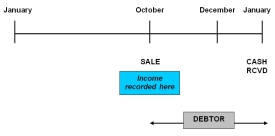


Finally, The Accrual Basis of Accounting is the unique system for recording credit items in accounting.
The accrual basis of accounting is covered in our lesson on income.
Please note that this is a slightly more advanced topic, so if you check out this lesson and find it difficult, just come back here and go through all the lessons in order. Soon enough you'll come right.
Test Yourself!
Before you start, I would recommend to time yourself to make sure that you not only get the questions right but are completing them at the right speed.
Difficulty Rating:
Beginner
Quiz length:
3 questions
Time limit:
5 minutes
Important: The solution sheet on the following page only shows the solutions and not whether you got each of the questions right or wrong. So before you start, get yourself a piece of paper and a pen to write down your answers. Once you're done with the quiz and writing down your answers, click the Check Your Answers button at the bottom and you'll be taken to our page of solutions.
Good luck!
What's Next?
In the next section, Basic Accounting Transactions, we'll go over what a transaction is, as well as the ten most common types of transactions, and see how each one affects the basic accounting equation.
Stay up to date with ABfS!
Follow us on Facebook:
Return from Basic Accounting Concepts to the Home Page
Lesson One: Basic Accounting Concepts (this lesson)
Lesson Two: Define Accounting
Lesson Three: Basic Accounting Equation
Lesson Four: What Are Assets?
Lesson Five: Liabilities: Definition and Examples
Lesson Six: What is Owners Equity?
Lesson Seven: The Accounting Equation and Financial Position
Lesson Eight: Basic Accounting Test
Questions Relating to This Lesson
Click below to see questions and exercises on this same topic from other visitors to this page... (if there is no published solution to the question/exercise, then try and solve it yourself)
Assignment Help:
Accounting for a Sole proprietorship vs Corporation
Q: I am a business student at South University. I'm taking an accounting class right now. This is one of the questions I had for my first assignment in …
© Copyright 2009-2026 Michael Celender. All Rights Reserved.
Click here for Privacy Policy.
Search this site:
Stay up to date with ABfS!
Follow us on Facebook:
All the lessons on this site and much, much more...
Available Now On